
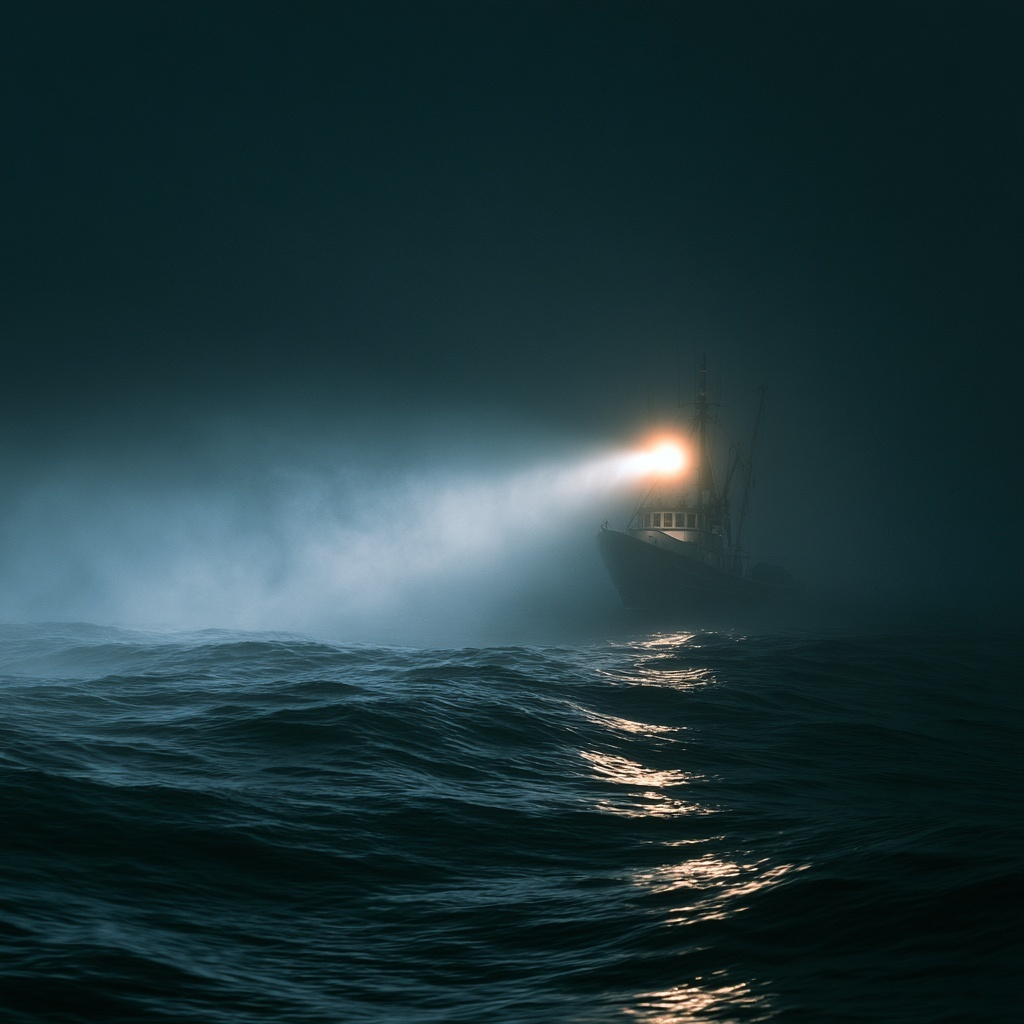
What Is the Best Color Temperature for Marine Lighting?
Lighting is critical to safety, visibility, and operational efficiency on the water—especially at night or in fog, rain, snow, and haze. One important specification is correlated color temperature (CCT), which describes whether a white light appears warmer and more yellow or cooler and more blue.
There is no single CCT that is best for every vessel, operator, and weather condition. However, understanding how CCT interacts with human vision, atmospheric conditions, glare, fixture design, and placement can help operators select a more effective marine lighting system.
What Is Correlated Color Temperature?
Correlated color temperature is measured in kelvin (K). It describes the color appearance of a nominally white light source:
- Below 2700K: amber or yellow-white
- 2700K–3500K: warm white with a yellowish appearance
- 4000K–5000K: neutral white
- Above 5000K: cool white with an increasingly bluish appearance
These categories are useful guidelines, not rigid standards. Two LED fixtures with the same stated CCT can still look different because CCT reduces a complex spectral output to a single number. The fixture’s spectral power distribution, chromaticity, output, optics, and surrounding conditions also affect how the light appears.
How CCT Affects Visibility at Night
Human vision changes as ambient light levels fall. Under photopic conditions, cone cells dominate vision. Under very low-light or scotopic conditions, rod cells become more important. Marine operations often occur in the intermediate mesopic range, where both systems contribute.
In practice, the perceived performance of a marine light depends on more than its CCT:
- Warm-white light may feel more comfortable and can reduce the harsh appearance of glare or backscatter.
- Neutral-white light can provide a useful balance of perceived contrast and color recognition.
- Cool-white light may appear crisp in clear conditions, but high blue content can produce more visually distracting scatter or reflected glare in some poor-weather environments.
Brightness alone does not guarantee better visibility. Excessive output, a poorly controlled beam, or light striking nearby rails, deck hardware, rigging, spray, or moisture can reduce contrast and make it harder to see beyond the illuminated foreground.
Marine Lighting in Fog, Rain, Snow, and Haze
Fog, rain, snow, sea spray, and haze can scatter light back toward the operator. This backscatter creates a luminous veil that reduces contrast and limits the distance at which objects can be detected.
It is tempting to say that blue light always scatters more than yellow light. That is generally true for very small particles in clear-air Rayleigh scattering, but fog droplets are much larger and are better described by Mie scattering. Their behavior is more complex and less strongly dependent on wavelength. As a result, lower CCT alone cannot eliminate backscatter.
Warm-white or amber-leaning lighting may still improve operator comfort and perceived visibility in some conditions, but effective performance also depends heavily on:
- Beam shape and cutoff
- Fixture placement and aiming
- Output level
- Distance from reflective vessel surfaces
- Droplet size and density
- Background luminance
- Operator adaptation and preference
Fog and Rain
In fog and rain, the goal is to illuminate the target area without flooding airborne moisture or nearby vessel structures with uncontrolled light. A warmer CCT may reduce the perceived harshness of backscatter, while careful optical control (beam pattern) can prevent more of the emitted light from returning to the operator’s eyes.
Snow and Haze
Snow and haze can create bright reflections and reduce contrast. A very cool source may make this reflected light feel more pronounced, whereas a warmer or neutral-white source, paired with proper aiming and controlled intensity, may make the scene easier to interpret.
Reflection From the Vessel
Although marine mast lights often project into open air, their beams can still strike bow rails, rigging, deck equipment, spray, and airborne moisture. Those reflections can be just as important as atmospheric scattering. Proper placement should keep foreground surfaces out of the primary beam whenever possible.
Is 4000K the Best CCT for Marine Lighting?
Approximately 4000K is a practical starting point for many marine applications because it offers a neutral-white appearance, useful color differentiation, and a balance between warm and cool light. It should not, however, be treated as a universal scientific optimum.
The available literature is limited, and much of the relevant research comes from automotive studies in inclement conditions rather than marine applications. Vessel design, mounting height, beam angle, operating speed, background conditions, and operator preference can all change the result.
Our experience over more than 10 years of providing forward mast lighting for marine and maritime applications points to a clear customer preference:
- Forward lighting: Many operators prefer warmer white or yellowish light around 2700K, with even some choosing 2200K.
- Aft lighting: A neutral-to-cooler range of approximately 4000K–5000K has often worked well.
This field experience supports a role-based approach rather than specifying one CCT throughout the vessel.
Why Fixtures With the Same CCT Can Look Different
Not every 4000K—or 2700K—fixture produces the same visual result. Differences in LED packages, phosphor coatings, binning, drive current, optics, and thermal conditions can change the appearance and performance of the emitted light.
Two products with the same nominal CCT may have different:
- Spectral power distributions
- Chromaticity coordinates and tint
- Color rendering
- Luminous output
- Beam patterns
- Glare characteristics
For this reason, CCT should be considered alongside photometric data, beam control, color rendering, and real-world testing.
Recommended Approach for Choosing Marine LED Lighting
For forward visibility in poor weather, begin by evaluating fixtures in the 2700K–4000K range. Then test the complete lighting system on the vessel under realistic operating conditions.
Consider the following:
- Match CCT to the task. Forward navigation, search, docking, deck work, and aft illumination may benefit from different color temperatures.
- Prioritize optical control. A well-shaped beam with appropriate cutoff can be more valuable than simply increasing wattage.
- Reduce reflected glare. Position and aim fixtures so they do not illuminate rails, rigging, deck hardware, windows, or other nearby surfaces.
- Use adjustable output when possible. The best intensity can vary dramatically between clear air and dense fog, rain, snow, or spray.
- Assess color quality. A color rendering index (CRI) above 80 may improve object and color recognition, but CRI alone does not predict visibility.
- Conduct an onboard trial. Compare fixtures from the operator’s normal viewing position and under the conditions the vessel regularly encounters.
Combining Warm and Cool CCTs in One Marine Lighting System
Mixed-CCT systems can give operators more flexibility than a single fixed color temperature. In one custom application for a smaller vessel operating in Alaska, we combined 2700K and 5000K light in a 480-LED-watt fixture. The design allows the installation to draw on the characteristics of both warm and cool white light.
An upcoming application will combine the same two CCT options across five fixtures with a total output of 3,600 LED watts.
Frequently Asked Questions
What color temperature is best for a marine searchlight?
There is no universal best CCT. A range of approximately 2700K–4000K is a useful starting point for forward lighting, with warmer options often preferred in fog, rain, snow, or spray. Beam control, mounting, output, and operator preference are equally important.
Are yellow marine lights better in fog?
Yellow or warm-white light may reduce perceived glare and feel more comfortable to some operators, but color alone does not solve fog backscatter. Optics, aiming, intensity, and fixture location have a major effect on usable visibility.
Is 5000K too cool for a boat?
Not necessarily. A 5000K fixture can perform well for aft illumination, deck work, and clear-weather applications. For forward lighting in dense moisture, some operators find a warmer CCT more comfortable and less visually harsh.
Does a higher CRI improve marine visibility?
Higher CRI can improve the appearance and differentiation of object colors, but it does not automatically increase detection distance. CRI should be evaluated together with beam pattern, illuminance, spectral output, glare control, and CCT.
The Bottom Line
Choosing a marine lighting color temperature requires balancing contrast, comfort, glare, weather, vessel geometry, and operator preference. A neutral-white source near 4000K can be a useful baseline, while many experienced operators prefer 2200K–2700K for forward lighting and 4000K–5000K for aft applications.
The most reliable choice comes from testing the actual fixture—not the CCT label alone—on the vessel and under realistic operating conditions.
Talk With Us About Your Marine Lighting Application
Need help choosing a CCT, beam pattern, or fixture layout for your vessel? Contact us to discuss your operating environment and develop a marine lighting solution suited to your application.
References
- Kang, H.-J., & Kwon, S.-J. (2021). “A Study on the Night Visibility Evaluation Method of Color Temperature Convertible Automotive Headlamps Considering Weather Conditions.” Applied Sciences, 11(18), 8661. https://doi.org/10.3390/app11188661
- Durmus, D. (2022). “Correlated Colour Temperature: Use and Limitations.” Lighting Research & Technology, 54(4), 363–375. https://doi.org/10.1177/14771535211034330
- International Commission on Illumination. “Correlated Colour Temperature.” CIE International Lighting Vocabulary, CIE S 017:2020.
- Federal Highway Administration. (2005). Enhanced Night Visibility Series, Volume XVII: Visual Performance During Nighttime Driving in Fog. FHWA-HRT-04-137.