
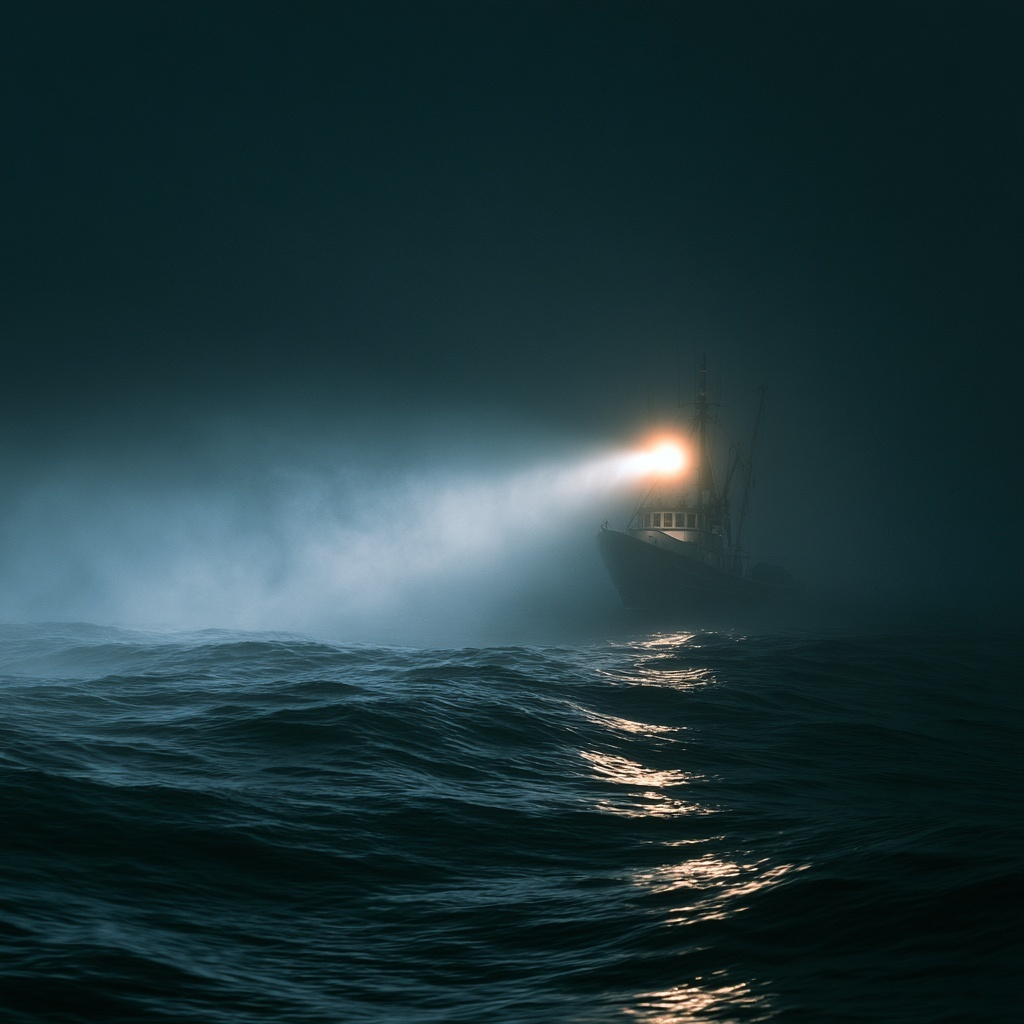
Introduction
Lighting in marine applications plays a critical role in ensuring safety, operational efficiency,
and optimal visibility, particularly in challenging weather conditions such as fog, heavy rain, and
snow. The selection of an appropriate Correlated Color Temperature (CCT) is a critical factor in
optimizing visibility. This draft explores a more ‘scientific’ basis behind selecting an optimal
CCT for marine environments, considering human vision, atmospheric scattering, and empirical
studies on light penetration through adverse weather conditions.
Understanding Correlated Color Temperature (CCT)
CCT is measured in Kelvin (K) and describes the color appearance of light emitted from a
source. General classifications include:
- Yellow white light (<2700K) – Perceived as yellow in color
- Warm white light (2700K–3500K) – Emits a yellowish hue
- Neutral white light (4000K–5000K) – Appears white – think fluorescent tubes
- Cool white light (5000K+–6500K) – May appear to have a slightly bluish tint
Human Vision and Marine Visibility
The human eye’s response to different wavelengths of light varies under different lighting
conditions. Scotopic (low-light) and mesopic (intermediate-light) vision mechanisms influence
how we perceive contrast and clarity, both important for low light environments: - Warmer temperatures (2700K–4000K) reduce glare and are better suited for
minimizing backscatter in fog and rain. - Cooler temperatures (5000K–6000K) tend to enhance contrast, making objects appear
sharper. - Daylight white (6000K and above) may however increase scatter and glare, reducing
visibility in inclement weather.
*These kelvin temperatures and ranges are not definitive.
Atmospheric Scattering and Light Penetration
Adverse weather conditions significantly impact how light propagates: - Fog and Rain: Water droplets scatter shorter wavelengths (blue light – higher CCT)
more than longer wavelengths (yellow or red light – lower CCT), causing higher
diffusion and reducing effective visibility and the distance at which objects can be clearly
seen. - Snow and Haze: Snow reflects a higher proportion of blue light (higher CCT) making it
harder to distinguish objects in front of the vessel; thus, cooler CCT sources can be less
effective in contrast enhancement. - Reflection and Refraction Considerations: In marine environments, most forwardfacing lights will experience little to no reflection or refraction, as they operate for the
most part, in open-air conditions without intervening surfaces. Unlike urban or
automotive lighting applications where reflective surfaces impact light effectiveness,
marine lighting must rely solely on direct projection and penetration through varying
atmospheric conditions.
Studies suggest that a CCT range of @ 4000K strikes an optimal balance by reducing backscatter
while maintaining high contrast and visibility in poor weather conditions.
Variability Among Manufacturers
As earlier noted, not all fixtures at the same given Kelvin temperature will appear identical
across different manufacturers. Variations in diode technology, phosphor coatings, and binning
processes can lead to noticeable differences in color output and rendering. Even within the same
stated CCT range, slight shifts in spectral composition can affect perceived brightness and
contrast. This variability underscores the importance of recognizing that different lighting
products may contribute a perceptibly different color of light.
Empirical and Industry Studies
A few studies provide some insights into CCT variances and selection for varying operational
conditions:
- Kang, H.-J., & Kwon, S.-J. (2021). “A Study on the Night Visibility Evaluation Method
of Color Temperature Convertible Automotive Headlamps Considering Weather
Conditions.” Applied Sciences, 11(18), 8661. This study evaluates how different CCTs
affect visibility in adverse weather conditions, providing insight into optimal lighting
choices. - Durmus, D. (2021). “Correlated Color Temperature: Use and Limitations.” Lighting
Research & Technology, 54(4), 1477–1493. This paper discusses CCT limitations and
perceptual differences in light sources, emphasizing that even identical CCTs can differ
significantly due to manufacturing variability.
Recommendations for Marine Lighting Applications
Given the absence of definitive marine-specific research and based on practical guidelines with
albeit limited existing literature, a suggested CCT for marine forward visibility in inclement
weather is approximately 4000K. This range provides:
- Sufficient contrast for object differentiation
- Minimal backscatter in fog and rain
- Reduced eye strain for operators
- Balanced visibility across various weather conditions
**Note: over the course of 10 years in providing forward (Mast) lighting for Marine and
Maritime applications the overwhelming consensus amongst our customers is their preference
for a warmer white/ yellowish fixture color (2700K), some even more recently opting for 2200K.
For aft applications a 4000-5000K solution has worked best.
That said, proper luminaire placement, glare-reduction optics, and higher Color Rendering
Index (CRI) sources (>80) may further enhance visibility.
Conclusion
Selecting the right CCT for marine lighting requires balancing visibility, contrast, and
atmospheric interactions. Although some empirical research supports @ 4000K as the optimal
range, it is ultimately dependent on what CCT works best for the operator given their operation,
experience and preference. Further, due to variability in LED manufacturing, it is important to
assess specific light sources under real-world conditions and under varying situations to assess
what is best for your operation.
Here is a custom application we did for a smaller vessel in Alaska (480 LED watts) that
combines both 2700K and 5000K effectively providing the benefits of both kelvin options into
one fixture. Stay tuned for an upcoming application combining the same kelvin options across
(5) fixtures, totaling 3600 LED watts.
References
- Kang, H.-J., & Kwon, S.-J. (2021). “A Study on the Night Visibility Evaluation Method
of Color Temperature Convertible Automotive Headlamps Considering Weather
Conditions.” Applied Sciences, 11(18), 8661. - Durmus, D. (2021). “Correlated Color Temperature: Use and Limitations.” Lighting
Research & Technology, 54(4), 1477–1493.